A smoke detector can be powered, tested, and apparently working and still give occupants less warning than they expect during a real fire.
This sounds contradictory. After all, if the smoke detector passes its monthly test, has a fresh battery, and produces a loud alarm, shouldn’t it detect a fire immediately?
Not necessarily.
A smoke alarm does not detect “fire” directly. It detects airborne products of combustion that reach its sensing chamber at a sufficient concentration to trigger the alarm. The time required for those particles to reach the detector and for the detector’s sensing technology to respond depends on the type of fire, the materials burning, room geometry, ventilation, airflow, detector location, ceiling configuration, alarm technology, and the condition of the device.
Fire dynamics matter just as much as the alarm itself.
Research from the National Institute of Standards and Technology (NIST) has shown that both ionization and photoelectric smoke alarms can provide escape time in most residential fire scenarios, but that escape times can sometimes be short. NIST also found that ionization alarms tend to respond more quickly to flaming fires, while photoelectric alarms often respond considerably faster to smoldering fires.
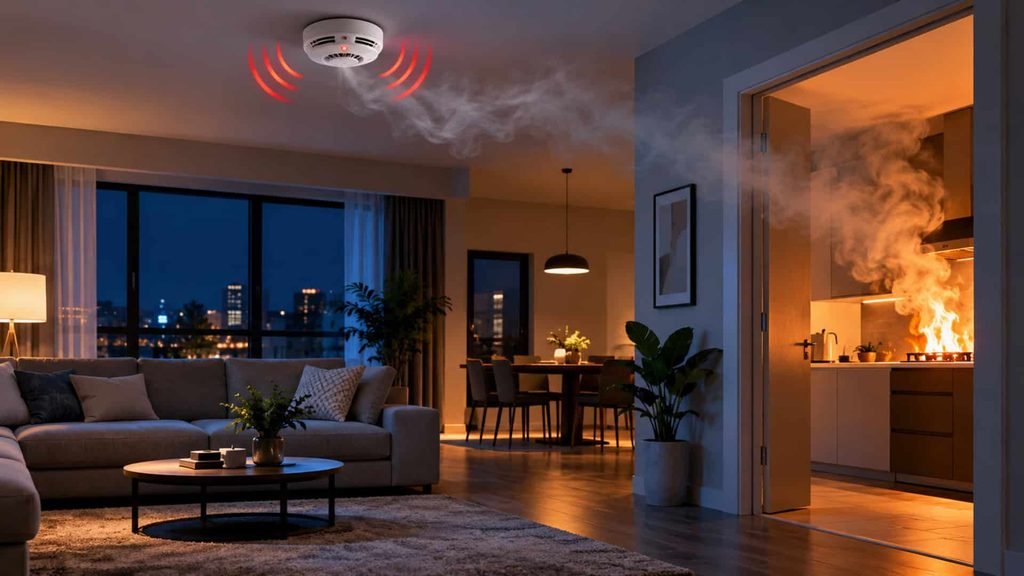
This is why “the smoke alarm works” and “the occupants will have plenty of time to escape” are not the same statement.
What Does “Working Smoke Detector” Actually Mean?
Before discussing delayed detection, it is important to define what a working smoke alarm means.
A smoke alarm may be considered operational when:
- It has power.
- Its electronics are functioning.
- The sensing chamber can detect particles.
- The alarm can produce its required audible signal.
- It has passed its test procedure.
- It has been installed according to applicable requirements and manufacturer instructions.
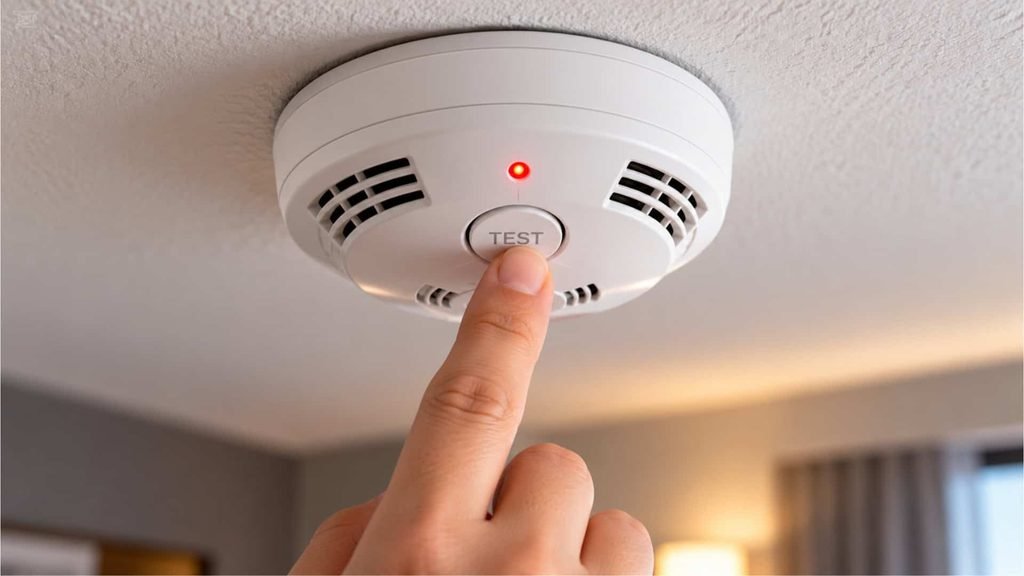
However, a functional device still has physical limitations.
The test button, for example, primarily confirms that the alarm’s electronics, power supply, and audible warning functions operate. It does not recreate every possible fire condition inside the room.
In other words:
A successful test does not mean the alarm will detect every type of fire at the same speed.
This distinction is particularly important in modern homes and buildings where fires can develop differently from the fires used in older detector-development assumptions.
NIST notes that modern furnishings and construction materials can contribute to faster fire development. Its research also found that escape times in modern residential fire tests were systematically shorter than those observed in comparable studies from the 1970s.
That shrinking escape window is one of the biggest reasons detector selection, placement, interconnection, maintenance, and evacuation planning matter.
1. Smoke Alarms Do Not Detect Every Fire the Same Way
There is no single “smoke” that every fire produces.
A fire can begin as a slow, oxygen-limited smoldering event or develop rapidly into open flaming combustion. Different materials produce different particle sizes and concentrations.
Two traditional smoke-sensing technologies are particularly important:
Ionization smoke alarms
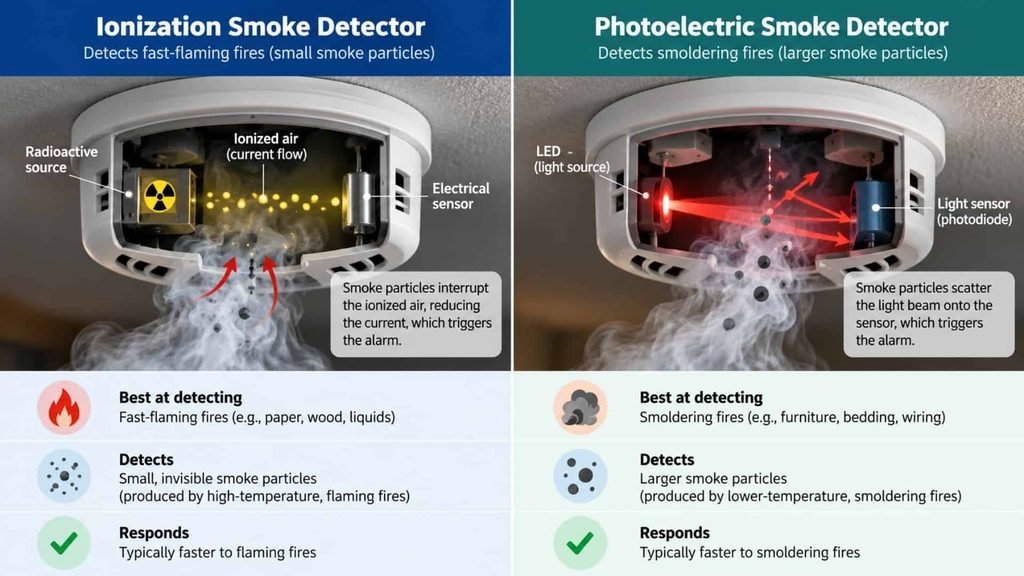
Ionization alarms use a small amount of radioactive material to electrically charge air molecules between two plates. When combustion particles enter the sensing chamber, they disrupt the electrical current, causing the alarm to respond when the particle concentration reaches its alarm threshold.
Ionization technology has historically been particularly responsive to many fast-flaming fires.
Photoelectric smoke alarms
Photoelectric alarms use a light source and photosensitive element. When smoke particles enter the sensing chamber, they scatter light toward the sensor. When the amount of detected light reaches the alarm threshold, the alarm activates.
Photoelectric alarms tend to have an advantage with many slow-smoldering fires, which can produce larger, lighter-colored particles.
This difference is important because a fire that starts as a smoldering event may behave very differently from a fire that transitions quickly into flaming combustion.
The U.S. Consumer Product Safety Commission (CPSC) notes that a photoelectric smoke alarm can respond minutes faster than an ionization alarm in some smoldering-fire scenarios. It also emphasizes that occupants should leave immediately when an alarm sounds because a smoldering fire can unexpectedly transition into flaming combustion.
What is the practical solution?
For residential applications, using appropriate combinations of detection technologies can reduce the risk associated with relying on one sensing principle alone.
CPSC has recommended using both photoelectric and ionization smoke alarms, while dual-sensor alarms are also available.
Modern listed smoke alarms have also evolved. NIST reports that the eighth edition of UL 217, which became effective for new smoke alarm certification in 2024, introduced a nuisance-alarm test and addressed concerns related to modern residential fire scenarios and different smoke alarm technologies.
The important lesson is not that one technology is universally “better.”
It is that fire behavior and detector response are closely connected.
2. A Smoke Alarm Needs Smoke to Reach It
This is one of the most overlooked reasons a working smoke alarm can appear to detect a fire too late.
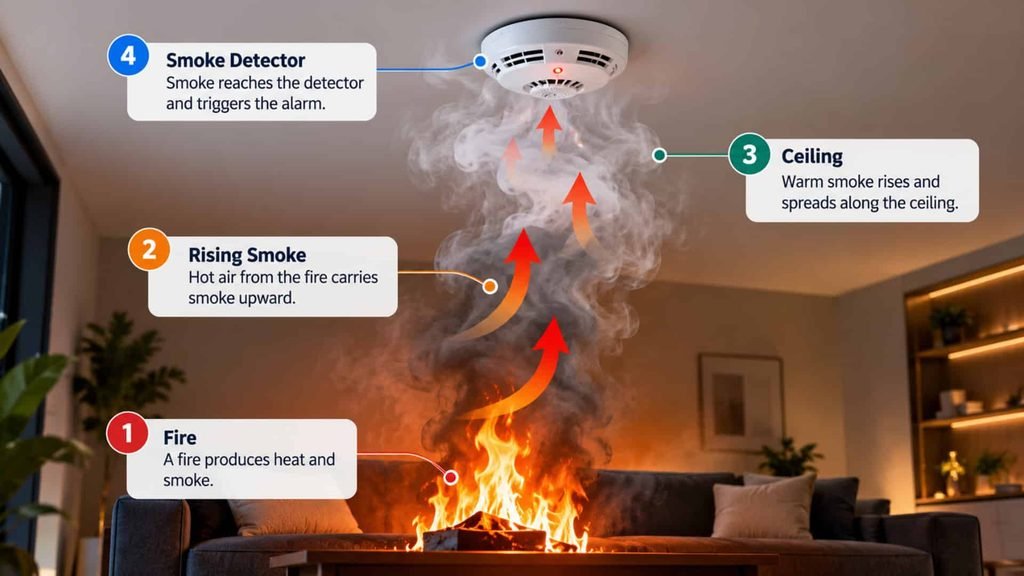
The alarm cannot respond to smoke that has not reached its sensing chamber.
Imagine a fire beginning inside a bedroom.
The smoke first accumulates around the burning object. Depending on the fire and ventilation conditions, smoke then moves upward, spreads beneath the ceiling, travels through openings, and eventually reaches the detector.
If the detector is in another room, around a corner, down a hallway, or separated from the fire by a closed door, the alarm may not receive the same smoke concentration at the same time.
This is why detector location is not simply an architectural decision.
It is part of the fire detection strategy.
For U.S. residential applications, NFPA guidance calls for smoke alarms in every bedroom, outside each sleeping area, and on every level of the home, including the basement. NFPA also recommends interconnected smoke alarms so that when one alarm operates, the others sound as well.
Canada’s federal home fire safety guidance similarly recommends smoke alarms in each bedroom, in the hallway outside bedrooms, and on each level of the home, including the basement, while noting that applicable provincial or territorial codes govern specific requirements.
The objective is straightforward:
Reduce the distance between the fire and the first detector capable of providing an effective warning.
3. A Closed Bedroom Door Can Change the Detection Timeline
Doors can be extremely important during a fire.
A closed bedroom door may slow the movement of smoke and heat from a fire in an adjacent room. That can help protect occupants.
However, it can also delay the movement of smoke toward a detector located outside that room.
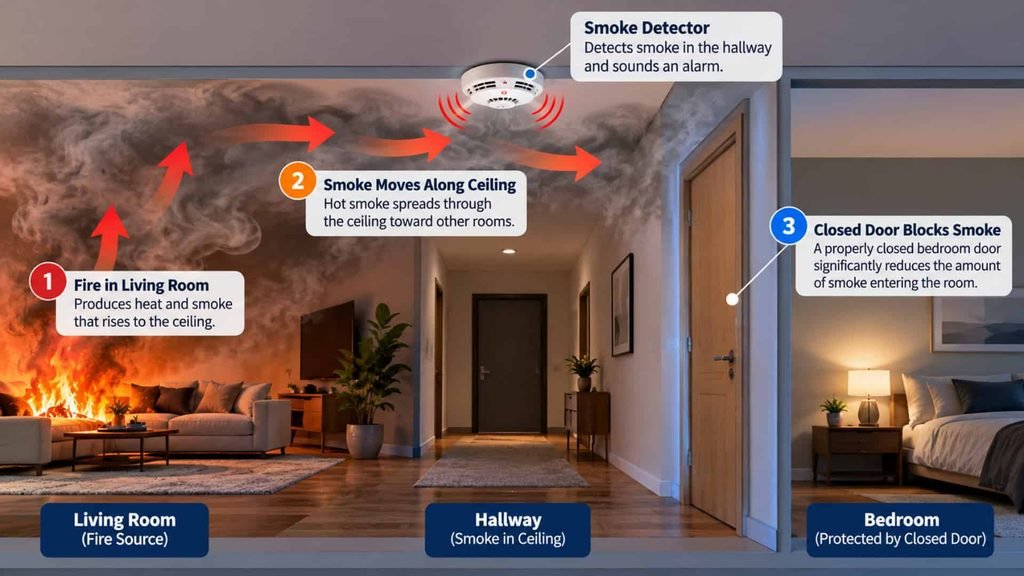
This is one reason residential fire protection strategies generally place smoke alarms inside bedrooms in addition to alarms outside sleeping areas.
The CPSC recommends smoke alarms on every level, outside sleeping areas, and inside bedrooms.
The principle is simple:
Don’t make one detector responsible for protecting multiple separated spaces when the applicable requirements call for detection within those spaces.
4. Poor Detector Placement Can Delay Detection
A detector can be perfectly functional but poorly located.
Smoke alarms are generally installed on ceilings or high on walls because smoke tends to rise. NFPA’s smoke alarm installation guidance recommends ceiling installation or high-wall installation, with specific positioning requirements for sloped and peaked ceilings.
But several environmental conditions can interfere with effective detection.
Examples include:
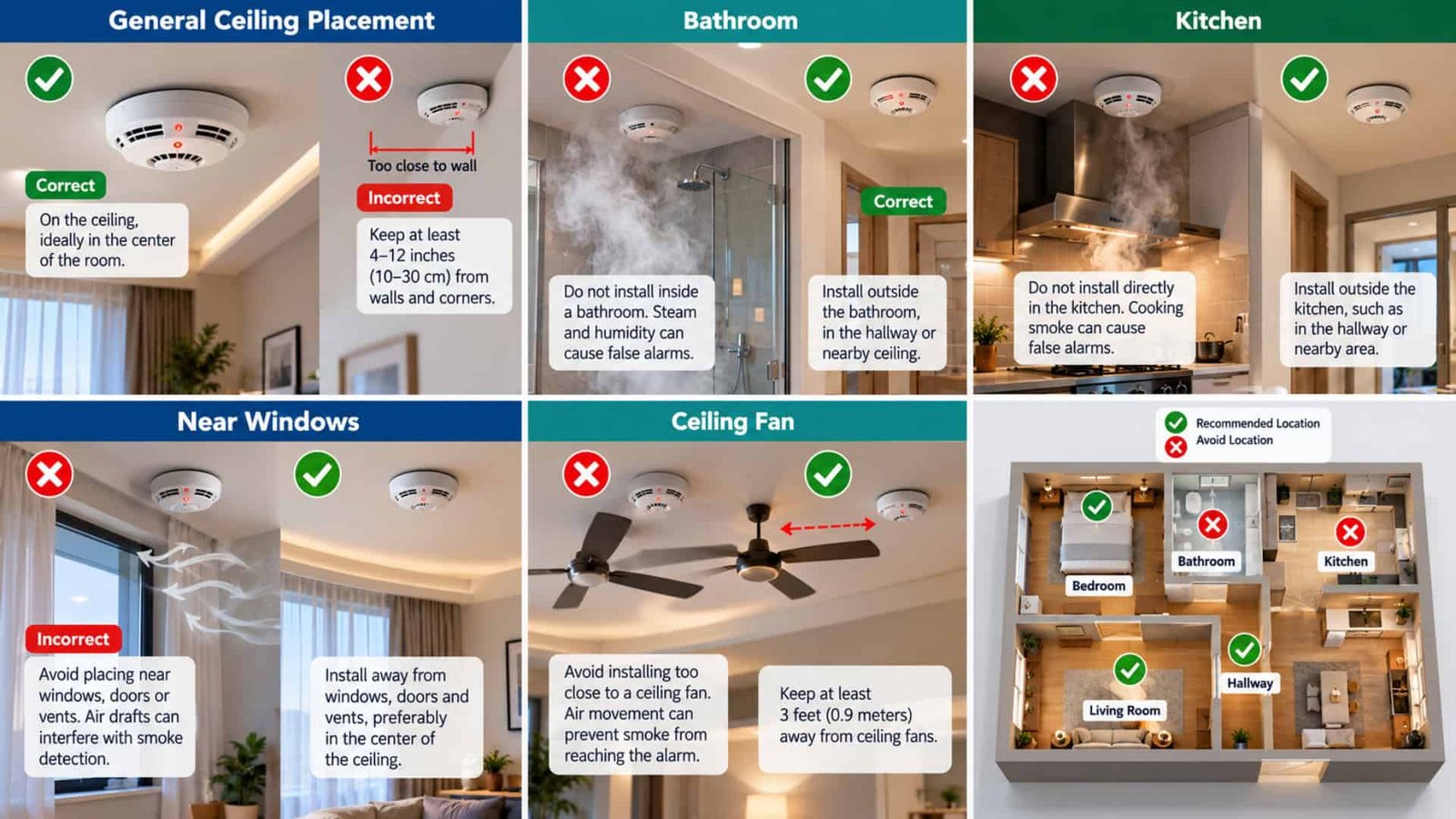
- Excessive distance from the potential fire source
- Dead-air spaces
- Poor ceiling geometry
- Strong airflow
- Ceiling fans
- HVAC supply or return air movement
- Windows and exterior doors
- Bathrooms producing steam
- Cooking appliances producing combustion particles
- Heating equipment
- Areas where dust accumulates
Ontario’s fire-safety guidance, for example, recommends installing smoke alarms on every storey and outside sleeping areas and avoiding locations too close to bathrooms, windows, ceiling fans, heating equipment, and cooking appliances.
The exact installation requirements depend on the applicable code and manufacturer’s instructions, so simply choosing a visually convenient location is not an appropriate installation method.
5. Airflow Can Move Smoke Away from the Detector
Modern buildings are full of air movement.
Forced-air heating and cooling systems, exhaust fans, ceiling fans, open stairwells, and pressure differences can influence how smoke travels.
This creates an important engineering problem:
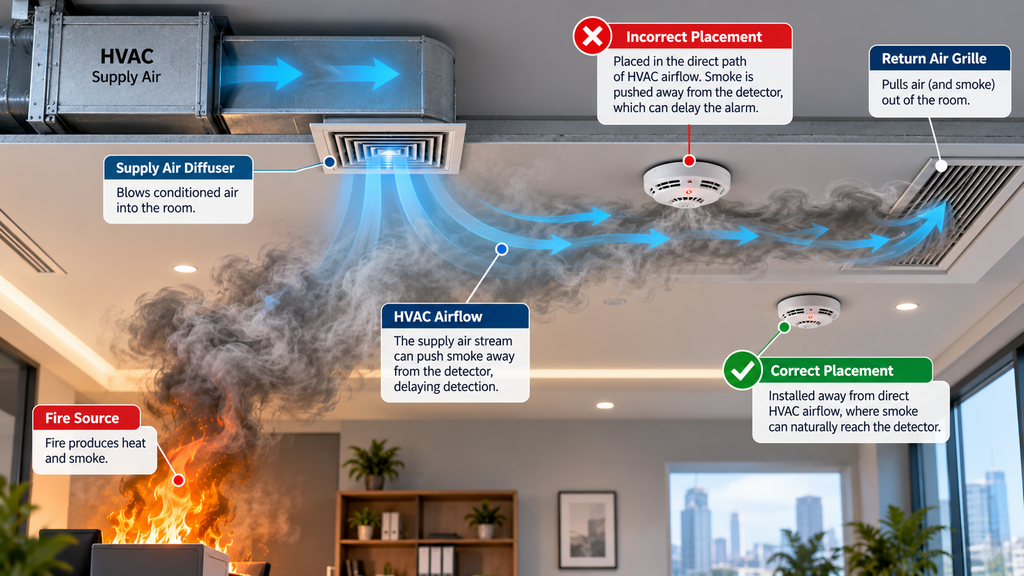
The detector responds to the smoke concentration that reaches it not necessarily the smoke concentration at the fire.
Suppose a fire starts in a room near an HVAC return.
Air movement could transport smoke toward another part of the building. Alternatively, an HVAC system or strong airflow could alter the normal upward movement of smoke.
In larger or more complex buildings, these effects become even more significant.
This is why commercial fire alarm design is not simply a matter of installing a detector wherever there is ceiling space. Detector spacing, environmental conditions, ceiling configuration, air movement, occupancy type, and the applicable fire alarm standard must all be considered.
For systems governed by NFPA requirements, the installation and design of automatic fire detection are addressed within NFPA 72 and related requirements.
6. High Ceilings Can Increase the Detection Challenge
A fire in a warehouse, industrial building, atrium, aircraft hangar, distribution center, or large commercial space behaves differently from a fire in an eight-foot residential room.
Smoke must travel farther before reaching a ceiling-mounted detector.
As the smoke plume rises, it can also entrain surrounding air, changing its temperature and concentration.
A conventional point smoke detector installed far above the fire may therefore not provide the same detection timeline as a detector installed in a smaller residential room.
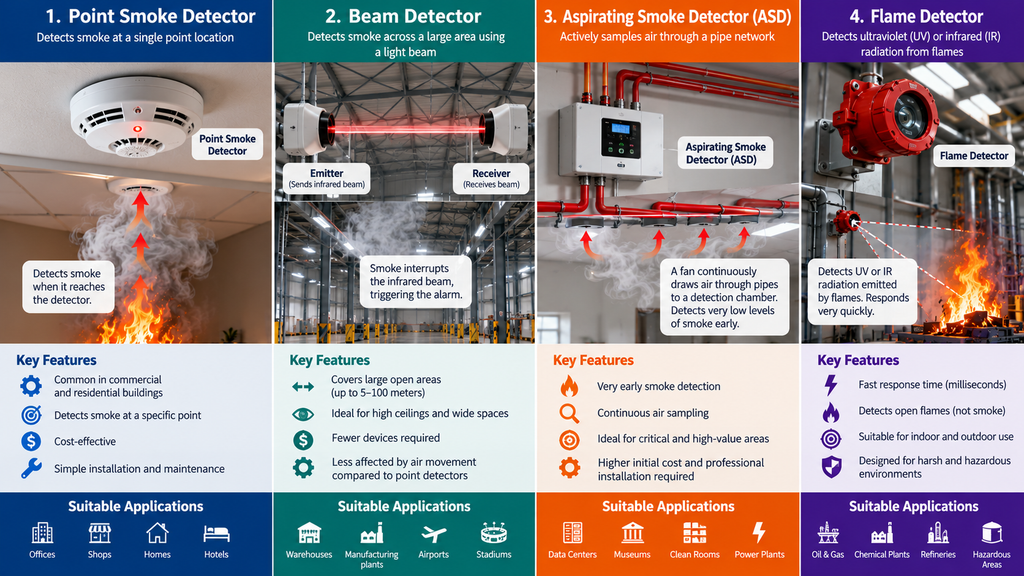
Large spaces may require different detection strategies depending on the hazard.
These can include:
- Beam smoke detection
- Aspirating smoke detection
- Air-sampling detection
- Video-based fire detection
- Linear detection
- Heat detection
- Flame detection
- Specialized detection systems
The appropriate technology depends on the application.
For example, an aspirating smoke detection system continuously draws air through sampling pipes and analyzes that air for smoke particles. In applications requiring very early warning such as data centers, telecommunications rooms, clean environments, archives, or certain industrial facilities this approach can provide detection before smoke concentration becomes significant enough for conventional point detection.
However, early warning capability should not be confused with replacing required code-compliant fire alarm protection.
7. Smoldering Fires Can Create a Different Detection Problem
Not all fires begin with flames.
A cigarette dropped onto upholstered furniture, an electrical fault inside a wall, overheated wiring, or certain types of combustible material can begin with smoldering combustion.
A smoldering fire may produce substantial smoke before visible flames develop.
This is one reason photoelectric detection can be valuable.
NIST’s testing found that photoelectric alarms often responded considerably faster to smoldering fires, while ionization alarms generally responded faster to flaming fires.
CPSC similarly explains that a photoelectric alarm can be minutes faster than an ionization alarm in some smoldering-fire situations.
The important point is that a “working” alarm can still have a response time influenced by the type of fire.
8. Modern Furniture Can Make the Escape Window Shorter
This is one of the most important developments in residential fire safety.
Today’s homes contain synthetic materials such as polyurethane foam, plastics, composite materials, synthetic textiles, and engineered wood products.
Some of these materials can contribute to rapid fire growth.
NIST has specifically reported that modern furnishings and mattresses can produce faster fire development than materials commonly found in older residential environments.
NIST’s work on the updated UL 217 standard also highlights the changing nature of residential fire scenarios and the need for smoke alarms to perform effectively with modern materials.
This means the question is no longer simply:
“Will the alarm detect the fire?”
A better question is:
“How much usable escape time will remain after the alarm activates?”
That is a much more meaningful fire-safety question.
9. Nuisance Alarms Can Create a Dangerous Cycle
A detector that activates frequently because of cooking smoke, steam, dust, or other non-fire conditions can become a nuisance.
Eventually, occupants may:
- Remove the battery
- Disconnect the alarm
- Cover the detector
- Relocate it
- Ignore repeated alarms
That creates a serious problem.
NIST specifically describes nuisance alarms as a safety concern because people may deactivate alarms when they experience frequent unwanted activations.
This is one reason newer smoke alarm standards have placed greater emphasis on reducing nuisance alarms while maintaining fire-detection performance.
The goal should not be to make alarms “less sensitive” simply to stop nuisance activations.
The goal is to use appropriately listed technology, correct placement, proper installation, and appropriate alarm selection for the environment.
10. Dust and Contamination Can Affect Performance
Smoke alarms operate in real-world environments.
Over time, dust, insects, airborne particles, and other contaminants can enter the sensing chamber.
Accumulated contamination can affect the detector’s operation and may also contribute to unwanted alarms.
This is why routine maintenance matters.
Ontario’s government fire-safety guidance recommends testing smoke alarms monthly, cleaning them according to appropriate procedures, and replacing smoke alarms at the end of their service life. It specifically notes that dust can clog smoke alarms and recommends gentle cleaning.
Canada’s federal guidance similarly recommends checking, testing, and cleaning smoke alarms according to the manufacturer’s instructions.
A detector should therefore not be considered “maintained” simply because it makes a sound when someone presses the test button.
11. A Ten-Year-Old Smoke Alarm Is Not the Same as a New One
Smoke alarms have a finite service life.
CPSC recommends replacing smoke alarms that are more than 10 years old.
NFPA likewise recommends replacing smoke alarms when they are more than 10 years old.
Canada also provides similar guidance. Ontario, for example, tells homeowners to replace older smoke alarms every 10 years according to the manufacturer’s instructions.
The reason is not necessarily that an alarm suddenly stops functioning on its tenth birthday.
Rather, electronics, sensing chambers, contamination, battery systems, and other components can age.
Therefore:
A green power indicator or successful test does not eliminate the need for periodic replacement.
12. Interconnection Can Reduce Warning Delay
Consider two scenarios.
Scenario A: Non-interconnected alarms
A fire begins in the basement.
The basement alarm activates.
Someone sleeping on the second floor may not hear it immediately because of:
- Distance
- Closed doors
- Building construction
- Background noise
- HVAC equipment
- Hearing limitations
- Sleep
Scenario B: Interconnected alarms
The basement alarm detects smoke.
It sends a signal to the other interconnected alarms.
Multiple alarms sound throughout the residence.
This can reduce the time between detection and occupant notification.
NFPA recommends interconnected smoke alarms for the best protection, and USFA guidance also identifies interconnected alarms as a preferred arrangement.
Interconnection can be achieved through hardwired systems or, where permitted and appropriate, listed wireless technology.
13. Hearing the Alarm Is Part of the Detection System
A technically correct smoke alarm is only useful if occupants can recognize the warning and respond.
Sleeping occupants present a particular challenge.
Smoke itself can also impair occupants. USFA educational material notes that smoke contains carbon monoxide and other hazardous products that can disorient people and cause loss of consciousness.
People who are deaf or hard of hearing may also require specialized notification.
NFPA recommends specialized devices for people who cannot depend on conventional audible alarms, including visual notification and bed-shaker technologies where appropriate.
Therefore, a complete residential fire-warning strategy has at least three stages:
Detect → Notify → Escape
A failure or delay in any one of these stages can reduce the available safety margin.
14. Smoke Alarm Placement in the U.S.
For U.S. homes, widely used NFPA guidance recommends smoke alarms:
- Inside every bedroom
- Outside each sleeping area
- On every level of the home
- Including the basement
NFPA also recommends interconnection so that activation of one alarm causes the others to sound.
CPSC provides similar residential guidance and recommends monthly testing and replacement of alarms more than 10 years old.
For installation details, the applicable edition of NFPA 72, local building/fire codes, and the manufacturer’s listing and instructions should be followed.
The exact requirements can vary depending on whether the building is a single-family residence, multifamily building, hotel, care facility, commercial property, or another occupancy.
15. Smoke Alarm Requirements in Canada
Canada does not operate under one single residential fire-code requirement that can simply be applied identically across every province and territory.
Provincial and territorial codes and municipal enforcement requirements matter.
At the national level, Canada.ca recommends smoke alarms in:
- Each bedroom
- The hallway outside sleeping areas
- Each level of the home, including the basement
It also advises homeowners to check, test, and clean alarms according to manufacturer instructions.
Ontario provides a useful example of jurisdiction-specific requirements.
Ontario states that homes must have a working smoke alarm on every storey and outside sleeping areas. Its guidance also specifies monthly testing, annual battery replacement where applicable, cleaning, and replacement of older alarms according to manufacturer instructions.
Ontario’s Fire Code also requires smoke alarms meeting CAN/ULC-S531 in applicable residential circumstances, with installation requirements tied to the Building Code and relevant standards.
This illustrates why fire-safety content for Canada should avoid saying that one installation rule automatically applies to every province.
16. CAN/ULC-S531 Matters in Canada
For Canadian residential smoke alarms, CAN/ULC-S531 is an important product standard.
Ontario’s Fire Code explicitly references smoke alarms conforming to CAN/ULC-S531.
This is different from simply buying a device that “looks like” a smoke alarm.
A compliant fire-safety product should have the appropriate certification/listing for the jurisdiction and application.
Similarly, installation should follow applicable requirements and manufacturer instructions.
For larger fire alarm systems, additional standards such as CAN/ULC-S524 and CAN/ULC-S537 may become relevant depending on the system and jurisdiction. Ontario’s Building Code, for example, references these standards in certain fire alarm system applications.
17. Smoke Alarm vs. Smoke Detector: They Are Not Always the Same Thing
The terms “smoke detector” and “smoke alarm” are often used interchangeably in everyday conversation.
Technically, however, they can describe different devices and system architectures.
A smoke alarm typically contains the sensing element and local notification device in one residential unit.
A smoke detector used in a commercial fire alarm system generally sends a signal to a fire alarm control unit, which manages notification and other system functions.
This distinction matters when discussing commercial buildings.
A commercial fire alarm system may integrate:
- Smoke detectors
- Heat detectors
- Manual pull stations
- Notification appliances
- Fire alarm control panels
- Supervisory devices
- Waterflow switches
- Duct detectors
- Monitoring interfaces
- Emergency control functions
The system is engineered as a whole.
Therefore, a commercial fire detection question cannot always be answered by applying residential smoke-alarm rules.
How to Reduce the Risk of Late Fire Detection
The solution is not simply “buy a more sensitive detector.”
A better strategy is to build layers of protection.
Layer 1: Choose listed and appropriate equipment
Use smoke alarms and fire detection equipment that are certified/listed for the intended application.
In the U.S., UL 217 is an important standard for smoke alarms.
In Canada, CAN/ULC-S531 is an important standard for residential smoke alarms.
Always verify the applicable requirements for the jurisdiction and occupancy.
Layer 2: Use the correct sensing technology
Consider the expected fire characteristics.
A residence can experience both smoldering and flaming fires.
Dual-sensor technology or an appropriate combination of technologies can provide broader detection capability.
Layer 3: Install detectors in the right locations
Follow applicable code requirements and manufacturer instructions.
Do not move a detector simply because its current location is inconvenient.
Layer 4: Interconnect alarms
Where appropriate, interconnect alarms so occupants in other parts of the home are alerted when one alarm detects smoke.
Layer 5: Maintain the system
Test alarms regularly.
Clean them according to the manufacturer’s instructions.
Replace batteries as required.
Replace alarms at the end of their service life.
Layer 6: Plan for human response
Every household should have a fire escape plan.
Everyone should know two ways out where possible.
The CPSC recommends having a fire escape plan, practicing it, and establishing a meeting place outside.
Frequently Asked Questions
Can a smoke alarm work properly but still respond late?
Yes. A smoke alarm responds when combustion products reach its sensing chamber at a sufficient concentration. Fire type, smoke movement, detector technology, location, airflow, ceiling height, and other environmental factors can affect response time.
Are photoelectric smoke alarms better for every fire?
No. Photoelectric alarms often respond faster to many smoldering fires, while ionization technology has historically responded faster to many flaming fires. NIST research supports the distinction, and CPSC has recommended both technologies or dual-sensor approaches for broader protection.
Why does my smoke alarm work when I press the test button but not detect smoke immediately?
The test button checks the alarm’s internal operation and notification function. It does not recreate every possible fire condition. A real fire must generate combustion particles that reach the sensing chamber at the required concentration.
Can a closed bedroom door delay smoke alarm activation?
Yes. A closed door can restrict smoke movement between rooms. This is one reason residential guidance calls for alarms inside bedrooms as well as outside sleeping areas.
How often should smoke alarms be tested?
For residential smoke alarms, NFPA and government safety guidance commonly recommends testing at least monthly. Ontario also specifically recommends monthly testing.
When should a smoke alarm be replaced?
CPSC and NFPA recommend replacing smoke alarms that are more than 10 years old. Always follow the manufacturer’s instructions and applicable local requirements.
Where should smoke alarms be installed in a U.S. home?
NFPA guidance recommends alarms inside every bedroom, outside each sleeping area, and on every level of the home, including the basement.
Where should smoke alarms be installed in Canada?
Canada.ca recommends alarms in each bedroom, outside sleeping areas, and on each level of the home, including the basement, subject to applicable provincial, territorial, and local requirements.
Does passing a smoke alarm test mean the alarm is fully reliable?
No. A test confirms important aspects of the device’s operation, but it does not prove that the alarm will detect every possible fire at the same speed. Proper placement, suitable technology, maintenance, interconnection, and replacement are all important.
Final Takeaway
A working smoke detector is essential—but “working” should never be confused with “instantaneous.”
Fire detection is a race between fire development, smoke movement, detector response, notification, and human escape.
A detector can only respond to smoke that reaches it. The type of fire determines what kind of smoke is produced. Detector technology influences how quickly that smoke is recognized. Building geometry and airflow influence how quickly smoke reaches the detector. Maintenance affects the device’s condition. Interconnection affects how quickly occupants elsewhere in the building receive the warning.
And perhaps most importantly, modern fires can develop rapidly enough that even a correctly functioning alarm may leave occupants with only a limited amount of usable escape time.
For homeowners and building operators in the U.S. and Canada, the practical approach is therefore to think beyond the question:
“Does my smoke detector work?”
Instead, ask:
“Is my entire fire-warning system designed to detect the types of fires I could realistically experience, alert everyone quickly, and give occupants enough time to escape?”
That means using properly listed equipment, following applicable U.S. or Canadian requirements, installing alarms in the correct locations, maintaining them, replacing aging devices, considering both major smoke-sensing technologies, interconnecting alarms where appropriate, and practicing a fire escape plan.
A smoke alarm is one component of fire safety.
Early detection, effective notification, and a practiced escape plan are what turn that alarm into life-saving protection.
Important: Fire-code requirements vary by state, province, territory, municipality, occupancy, building age, and applicable code edition. This article is intended for fire-safety education and should not replace the requirements of the authority having jurisdiction (AHJ), applicable building/fire codes, NFPA requirements, CSA/ULC standards, or the manufacturer’s installation instructions.
